Data Leaves Your Device
All online transactions begin locally. Your device, either a laptop, smartphone or tablet, makes a request: it might be a call to a particular casino website and its casino bonus page, a video streaming platform, email, or some other interactive application and an Internet session. It is all about some form of communication where the messenger application tells the operating system, which then tells the network interface to send a request over the network in some form - or rather, those parts of the network that carry forward the dealt information according to some predefined cues.
Before the data starts its journey out of the client's system, it is broken down into tiny segments referred to as packets. Such packets contain bits of the original request, as well as address information. The latter part involves information such as your device's IP address and the destination address. Ever ready to emerge independently from all networks, each of these packets subsequently combines its strength through networks until they get to the destination where they may be rearranged.
From Application to Network Stack
When you enter a web address, your browser first checks whether it already knows the destination’s IP address. If not, it sends a request to a Domain Name System server to translate the human-readable domain name into a numerical IP address. This translation step is essential because network devices route traffic using IP addresses, not names.
Once the address is known, your browser hands the request to the transport layer. Protocols such as TCP manage how packets are divided, numbered, and checked for errors. This structure ensures that even if packets take different paths, they can be reassembled in the correct order at their destination.
Passing Through Your Local Network
After leaving your device, the data reaches your router. In a home setting, this is usually your Wi-Fi router. In an office, it may be part of a larger internal network with multiple switches and firewalls. The router’s job is to forward your packets toward your internet service provider.
At this stage, your data moves from a private local network into a public one. Network Address Translation may modify the source address so multiple devices in your home can share a single public IP address. From there, your packets enter your provider’s infrastructure and begin their journey across larger networks.
It Gets Encrypted (TLS / HTTPS)
In the 21st century, internet communication is heavily dependent on encryption, none to be left untouched. For example, once connected to a HTTPS-enabled website, your browser secures connections through Transport Layer Security (TLS). The internet connection will then proceed to protect your data while it flies through the cables, leaving behind only gibberish to help any eavesdropper get nothing; in the latter, they both encrypt and composer data so that any and all eavesdroppers can see that someone is communicating with a server somewhere, but they cannot simply look at what is being exchanged.
The TLS Handshake
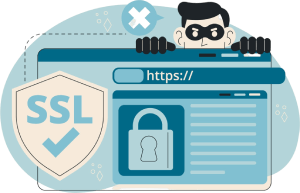
Before secure communication begins, your browser and the server perform what is known as a TLS handshake. During this process, the server presents a digital certificate issued by a trusted certificate authority. Your browser verifies that the certificate is valid and belongs to the intended domain.
Once verified, both sides agree on encryption keys. These keys are used to encrypt and decrypt the data exchanged during the session. This handshake happens quickly, often in milliseconds, but it establishes the secure foundation for everything that follows.
It Travels Across Global Networks
Once encrypted and packaged, your data begins traveling across interconnected networks. The internet is not a single entity but a vast collection of networks operated by service providers, corporations, universities, and governments. These networks exchange traffic using standardized routing protocols.
Routers along the way examine the destination IP address in each packet and determine the next best hop. Decisions are made dynamically based on network conditions, policies, and availability. If one path becomes congested or unavailable, traffic can be rerouted automatically.
Internet Service Providers and Backbone Networks
Your packets first move through your internet service provider’s infrastructure. From there, they may pass to larger backbone providers that carry traffic over long distances, including across continents. High-capacity fiber optic cables, many laid under oceans, form the backbone of global connectivity.
These submarine cables transmit data as pulses of light through optical fibers. Despite the vast distances involved, the speed of light in fiber allows information to travel remarkably quickly. Still, physical distance affects latency, which is why servers closer to users often provide faster responses.
It Reaches Cloud Servers
Eventually, your data arrives at a data center. These facilities house thousands of servers that store websites, applications, and databases. Many services today rely on cloud providers that operate large-scale infrastructure across multiple geographic regions.
When your packets reach the correct server, they are reassembled into the original request. The server processes the request, retrieves any necessary data, and prepares a response. That response is then divided into packets and sent back through the network to your device.
Inside a Data Center
Data centers are engineered for reliability. They include redundant power supplies, cooling systems, and network connections. If one component fails, others can take over. This redundancy supports high availability and minimizes downtime.
Servers inside these facilities often run virtualization or container technologies, allowing multiple applications to share hardware resources securely. Load balancers distribute incoming traffic across multiple servers, preventing overload and improving performance for users around the world.
It’s Stored in Secure Data Centers
When data needs to be retained, it is stored inside professionally managed data centers built for resilience and protection. These facilities use strict physical access controls, surveillance systems, and environmental safeguards to prevent unauthorized entry and equipment failure. Servers operate in climate-controlled rooms with backup power and fire suppression systems.
Data is often replicated across multiple machines or even different geographic regions. Regular backups and redundancy reduce the risk of loss and support continuity. Together, these safeguards help ensure stored information remains secure, available, and protected against disruption.
Bringing It All Together
Every time your information is loaded to a system, it moves out from your device through encrypted channels, traverses the internet, and lands into a guarded data store before joyously hopping back again. Every step of this venture, from packet routing until server processing and storage, performs great deeds in ensuring mapping, reliability, and security of the information. In simpler language, one system combines countless compartments, once sealing technological capacity with a vast breadth of security protocols only to make the processing of online transactions feel straightforward.